

A spreadsheet can carry a young business surprisingly far, right up to the first tax deadline, the first chase for a late invoice or the first month with more receipts than evenings. Cloud accounting software for small business is the step after that, and the five tools below are the ones owners realistically choose between.
We read every plan on each vendor’s own pricing page in October 2026 and compared what actually decides the bill. It is rarely the headline price. QuickBooks Online meters users, FreshBooks meters billable clients, Zoho Books meters the whole organization, Wave meters automation, and Xero refuses to meter people at all. That metering choice moves your yearly cost more than any entry price, so it runs through every section below. All figures are standard rates: where a vendor is running a launch discount, we say so and quote the normal price.
Whether you do your own books on a Sunday night or share them with a bookkeeper and an accountant, one of these five fits. The differences are in the caps, and the caps are all written out.
Quick facts, checked October 2026
- Three of the five have a real free plan: Wave, Zoho Books and QuickBooks Online
- Cheapest paid year: Zoho Books Standard at $15 a month on annual billing
- Xero charges no per-user licence fees on any plan
- QuickBooks Online Simple Start is $38 a month for one user
- FreshBooks counts billable clients, not invoices: 5 on Lite, 50 on Plus
- Payroll is a paid add-on on every tool here, never in the base price
The five tools at a glance
| Tool | Free plan | First paid plan | You pay for | Users |
|---|---|---|---|---|
| Xero | None, one month free trial | Early, $27 a month | Feature tier only | No per-user fees |
| QuickBooks Online | Yes, 2 invoices monthly | Simple Start at $38 monthly | Seats | Single user on Simple Start |
| FreshBooks | None, 30 day trial | Lite, $23 a month | Billable clients | Team members $11 each |
| Zoho Books | Yes, 1,000 invoices a year | Standard, $15 a month billed annually | The organization | 3 users on Standard |
| Wave | Yes, unlimited invoicing | Pro, $19 a month | Automation features | Adding users is Pro only |
Read the table by its fourth column. Two businesses can pay the same entry price and end the year hundreds of dollars apart, simply because one tool counts the thing they have a lot of. Picture three buyers. A consultant billing forty clients runs straight into the FreshBooks client ceiling. A six person team climbs the QuickBooks per-seat ladder with every hire. A business sending five invoices a year hits neither wall, and can choose on features alone. Keep your own meter in mind as you read each section.
Xero: the one that never charges per user
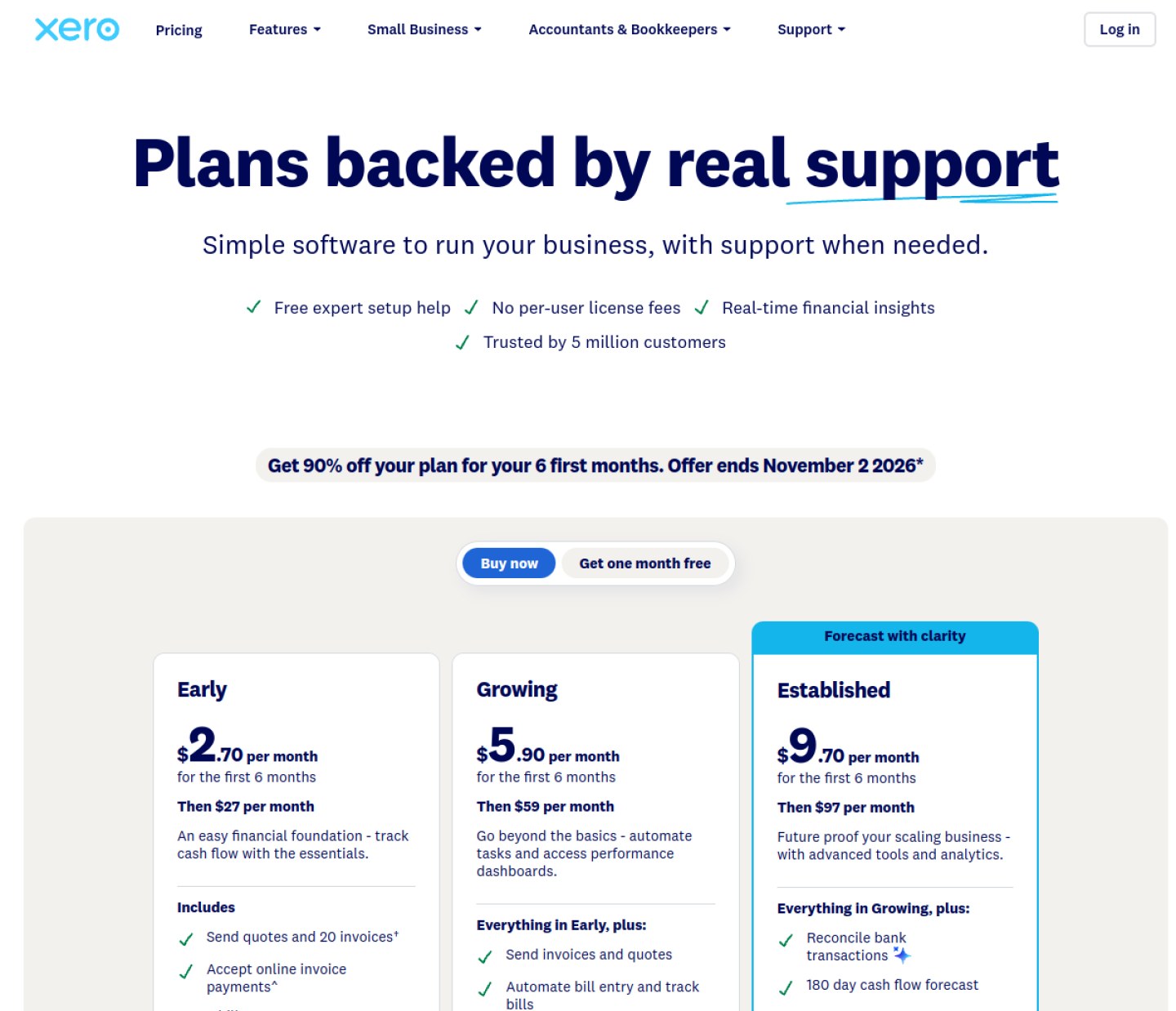
Xero’s defining policy is an absence: no per-user licence fees on any plan. Your whole team and your accountant can work in the same books without the subscription moving a cent, which makes Xero the most predictable bill in this comparison. Around that policy sits a complete package: bank reconciliation on every plan, real-time reports, and cash flow forecasts that stretch from 30 days on the entry plan to 180 days on the top plan. Invoices can be paid online, including tap to pay through Stripe.

The ladder has three rungs. Early, at $27 a month, covers quotes and 20 invoices a month plus 5 bills, which suits a business with a short client list. Growing, at $59, lifts those caps and adds bulk bill entry and performance dashboards. Established, at $97, is the full analytical tier. There is no free plan, though the first month is free as a trial. Two extras are worth knowing about before you budget: payroll runs through Gusto as an add-on at $36 a month plus $6 per employee, and automatic reconciliation costs $5 a month on Early and is included above it. Xero is currently discounting the first six months by 90% until early November 2026; every price quoted here is the standard rate you pay after any such offer ends.
What we like
- No per-user fees, so the team can grow inside one price
- Cash flow forecasts built into every tier’s reporting
- Bank reconciliation included from the entry plan up
What could be better
- No free plan, only a one month trial
- Early caps you at 20 invoices and 5 bills a month
- Payroll is a paid add-on, not part of the subscription
QuickBooks Online: the default your accountant already knows
QuickBooks Online is the name most US accountants reach for first, and that familiarity is a feature in itself: hand your books to almost any US firm and they open this tool. The feature bench is the deepest here, with AI assisted invoicing, automatic expense categorization, real-time reporting and, on the upper plans, inventory tracking. If a small business accounting feature exists, it usually exists here first.
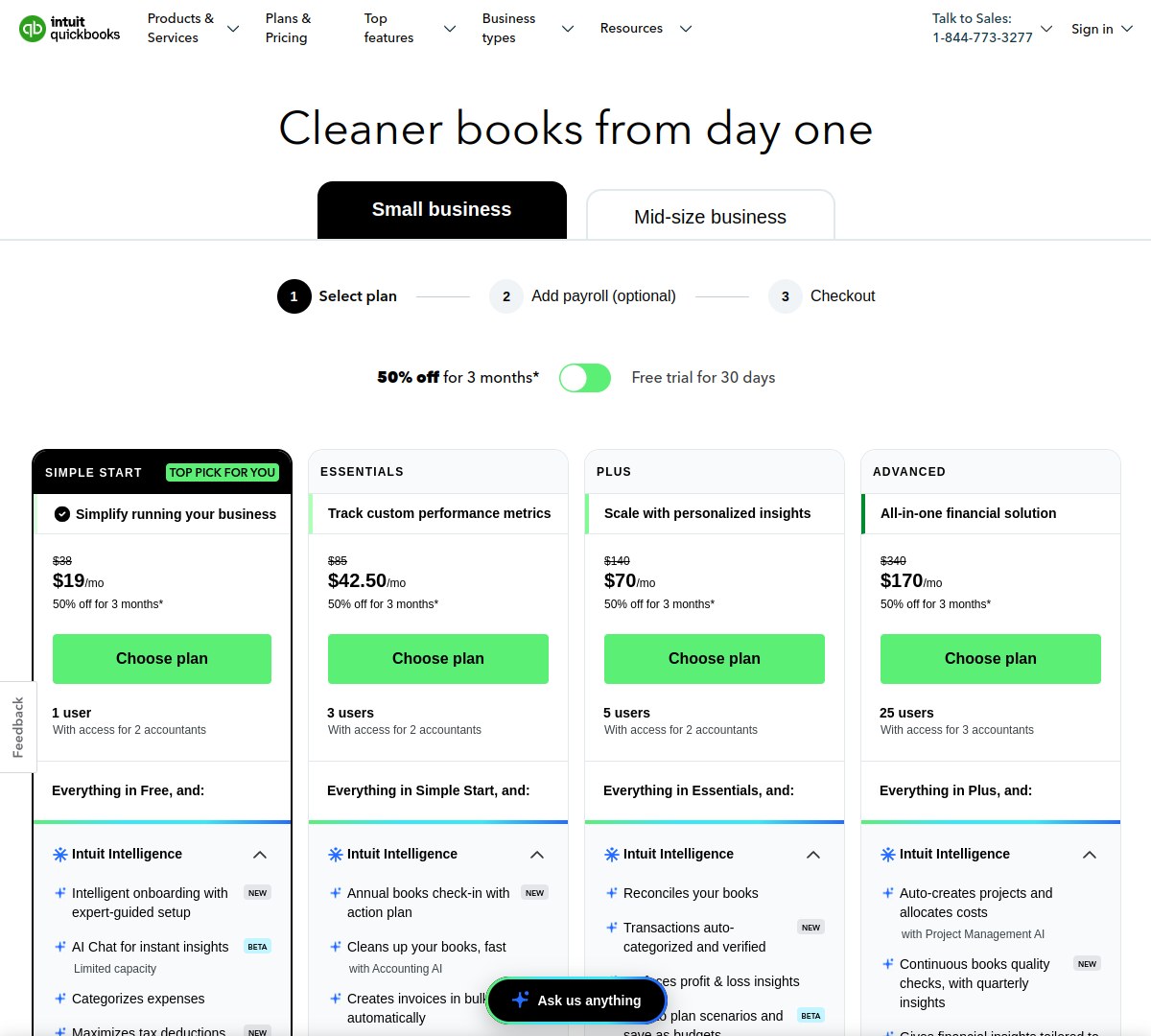
There is now a free plan, and it is tightly fenced: one user, two invoices a month, one bank account and no accountant access. Treat it as a taster. The paid ladder meters people. Simple Start is $38 a month for one user plus two accountant seats, Essentials is $85 for three users, Plus is $140 for five users and adds inventory, and Advanced is $340 for twenty-five users. Payroll is not inside any of these prices; it is an add-on you choose at checkout. New customers are currently offered 50% off the first three months, and every figure in this section is the standard rate after that window closes.
What we like
- Deepest feature set of the five, inventory included on Plus
- The tool most US accountants already work in
- A free plan exists for a first look at the books
What could be better
- Simple Start covers a single user only
- The ladder climbs steeply, $38 to $340
- Payroll always costs extra on top
FreshBooks: built around the invoice, not the ledger
FreshBooks starts from the document a client actually sees. Invoices are unlimited and fully customized on every plan, with recurring invoices and automatic late payment reminders, and clients can pay by card, ACH transfer, Apple Pay, Google Pay or buy now pay later. Time tracking and expense capture are unlimited too, which is why so many service businesses land here: the tool is arranged around billing hours and chasing payment politely, with the accounting underneath.
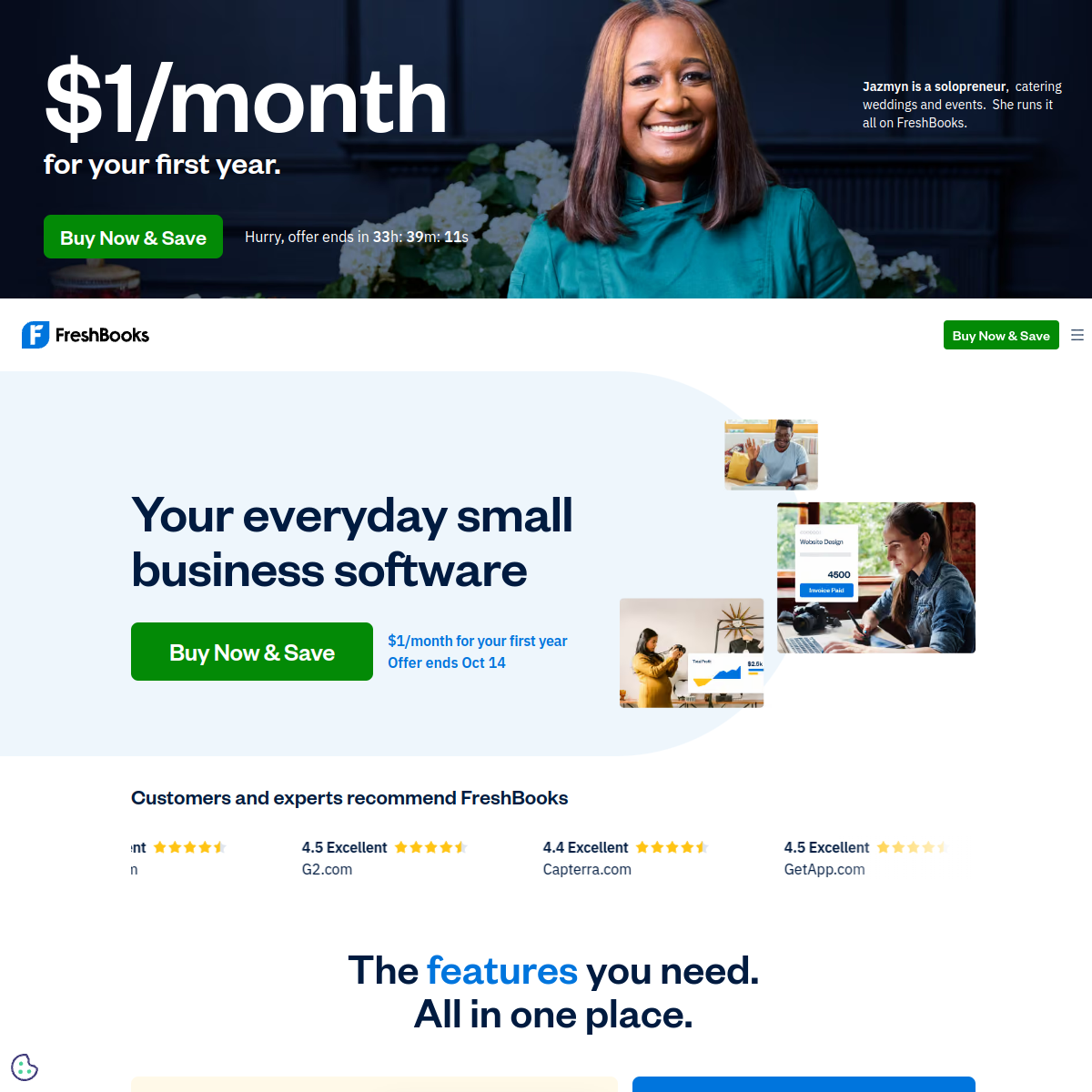
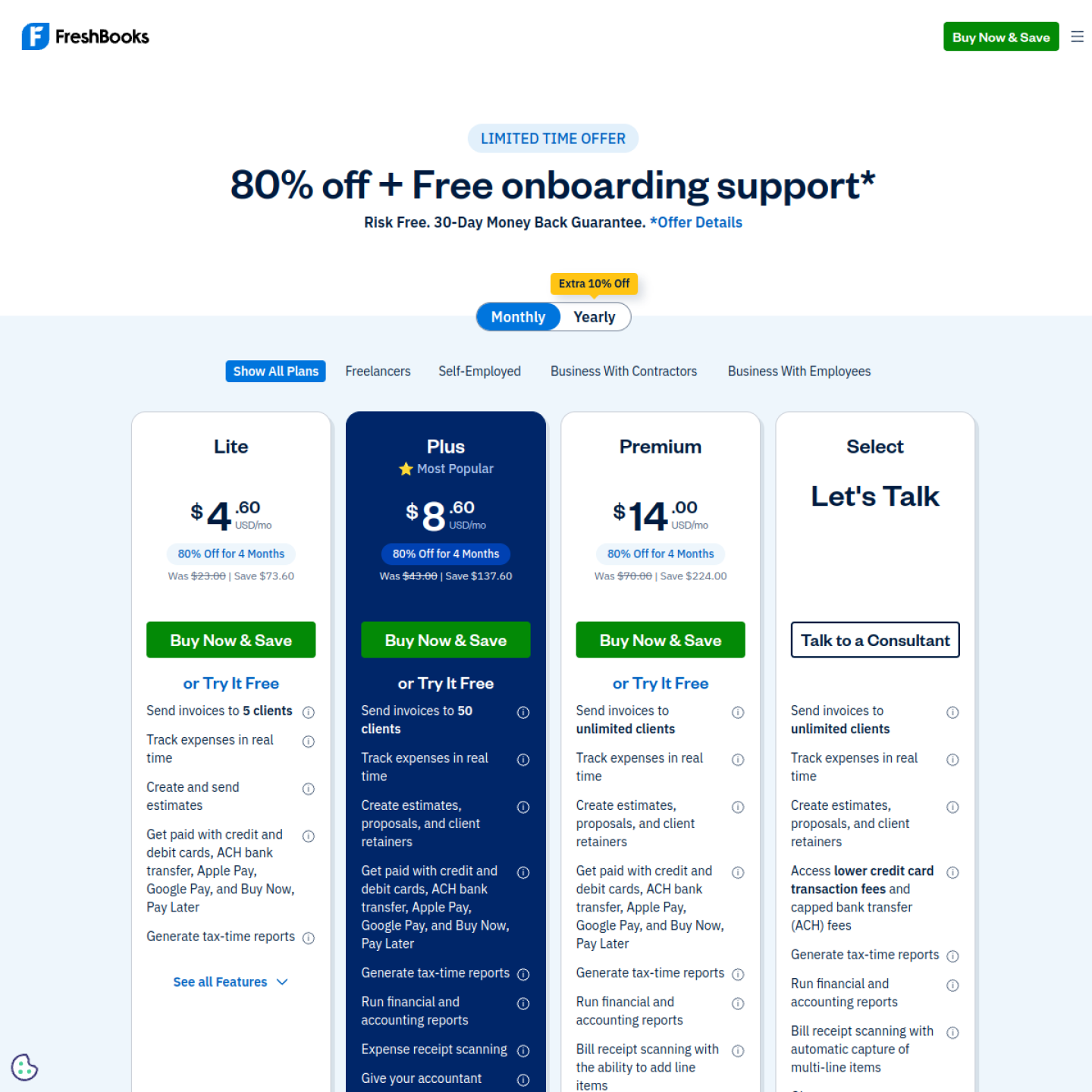
The meter here is people you bill, not documents you send. Lite, at $23 a month, covers 5 billable clients; Plus, at $43, covers 50; Premium, at $70, removes the cap. Read that against your client list before anything else, because a consultant with thirty active clients outgrows Lite in week one. Team members cost an extra $11 per person a month on every plan. Bank imports are included throughout, while bank reconciliation and double-entry reports begin at Plus, and payroll is an add-on at $40 a month plus $6 per user. FreshBooks has no free tier; its trial runs 30 days and asks for no card up front.
What we like
- Unlimited invoices on every plan, free plan or not
- The widest set of client payment options here
- Time tracking and expenses unlimited throughout
What could be better
- Client caps bite early: 5 on Lite, 50 on Plus
- Each team member adds $11 a month
- No inventory tools in the plan comparison
Zoho Books: the value pick with a free plan that holds up
Zoho Books is the budget end of this list, and unusually, the free plan is not a token. It covers one user plus an accountant, up to 1,000 invoices a year, online payments, a customer portal and more than 50 reports, which is a workable set of books for a business in its first year. Sales tax tracking and 1099 contractor tracking with e-filing are in the product too, the kind of compliance detail that usually hides in expensive tiers.
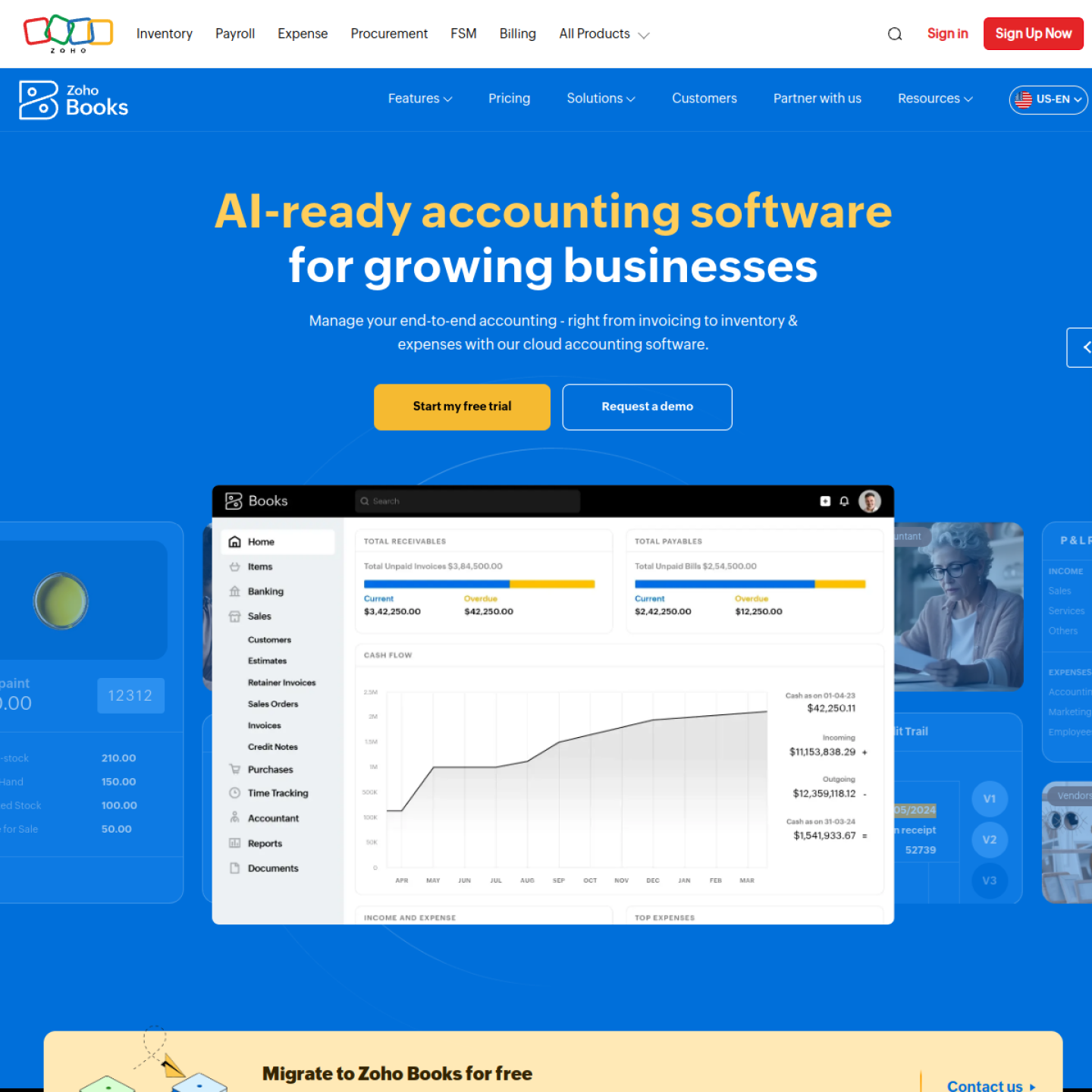
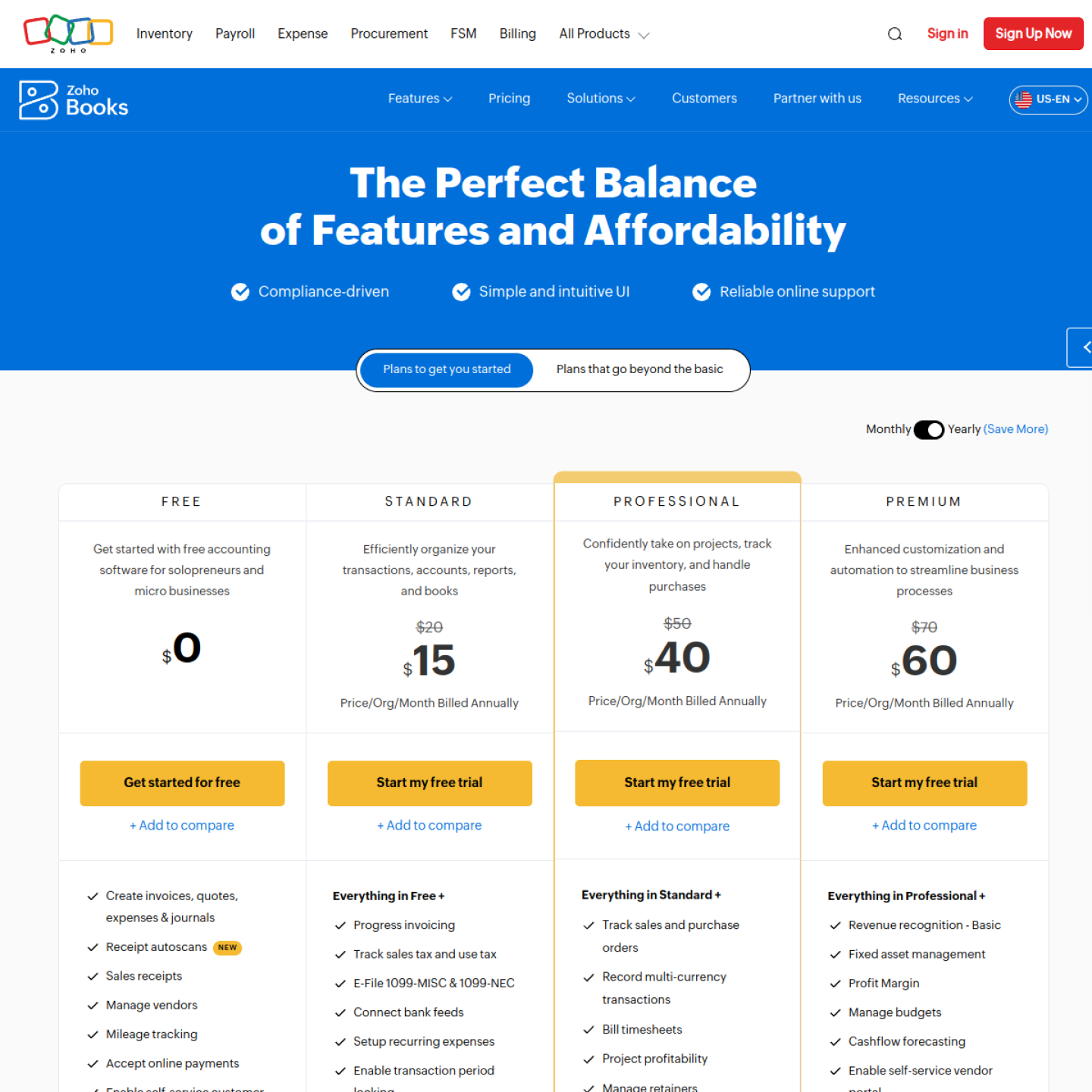
Paid tiers are charged for the whole organization, not per seat. Standard costs $15 a month billed annually ($20 monthly) for three users and 5,000 invoices a year. Professional, at $40 on annual billing, adds inventory tracking, and Premium at $60 lifts the invoice ceiling to 25,000 a year. Adding another user costs just $2.50 a month. The gaps are deliberate: payroll is a separate Zoho app rather than part of Books, and the interface packs more onto each screen than FreshBooks or Wave do, so it takes a little longer to learn your way around.
What we like
- The lowest paid prices in this comparison
- Free plan with 1,000 invoices a year and 50 plus reports
- Extra users cost just $2.50 a month each
What could be better
- Inventory tracking waits until the Professional plan
- Payroll lives in a separate Zoho app
- A denser interface than the simpler tools here
Wave: the free plan people actually stay on
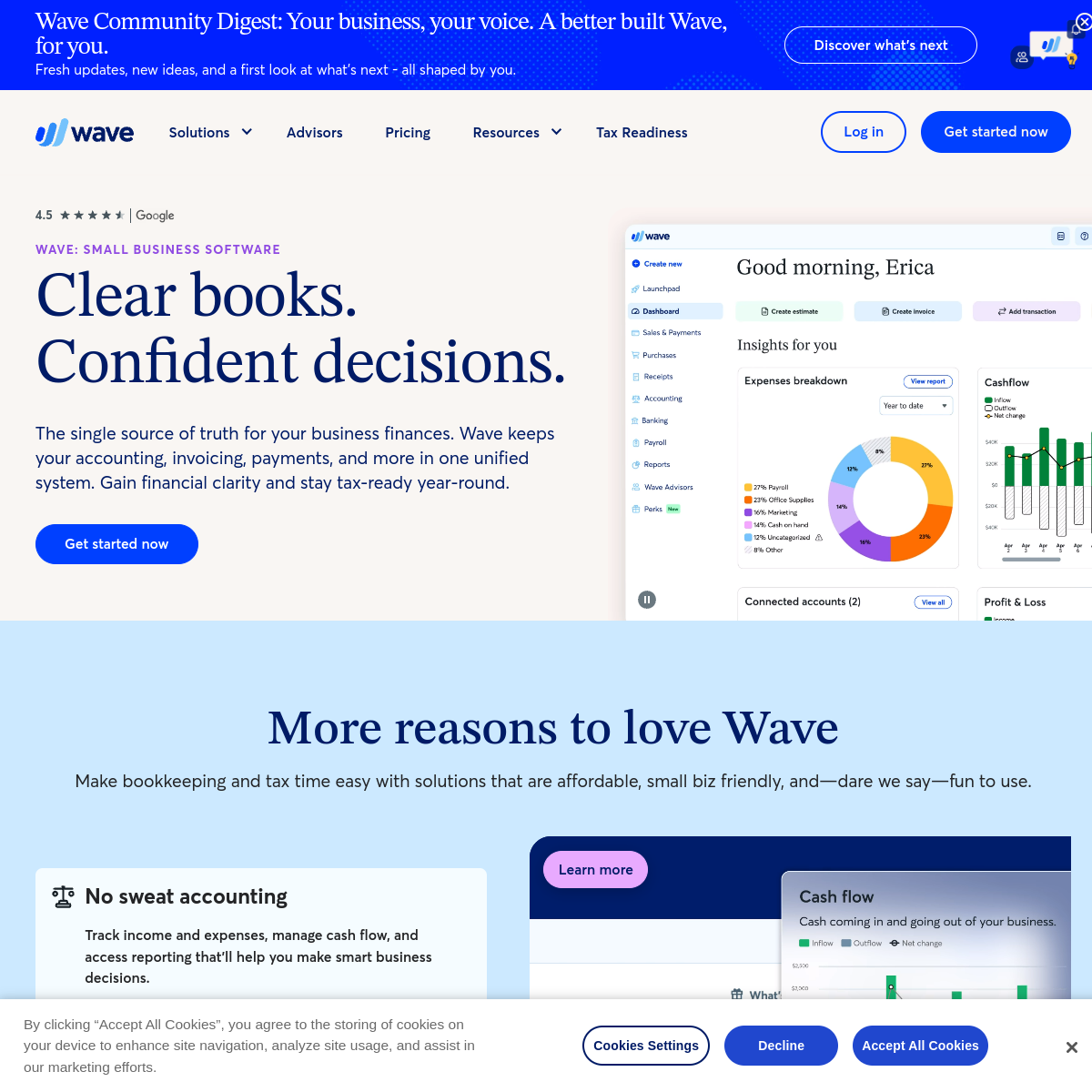
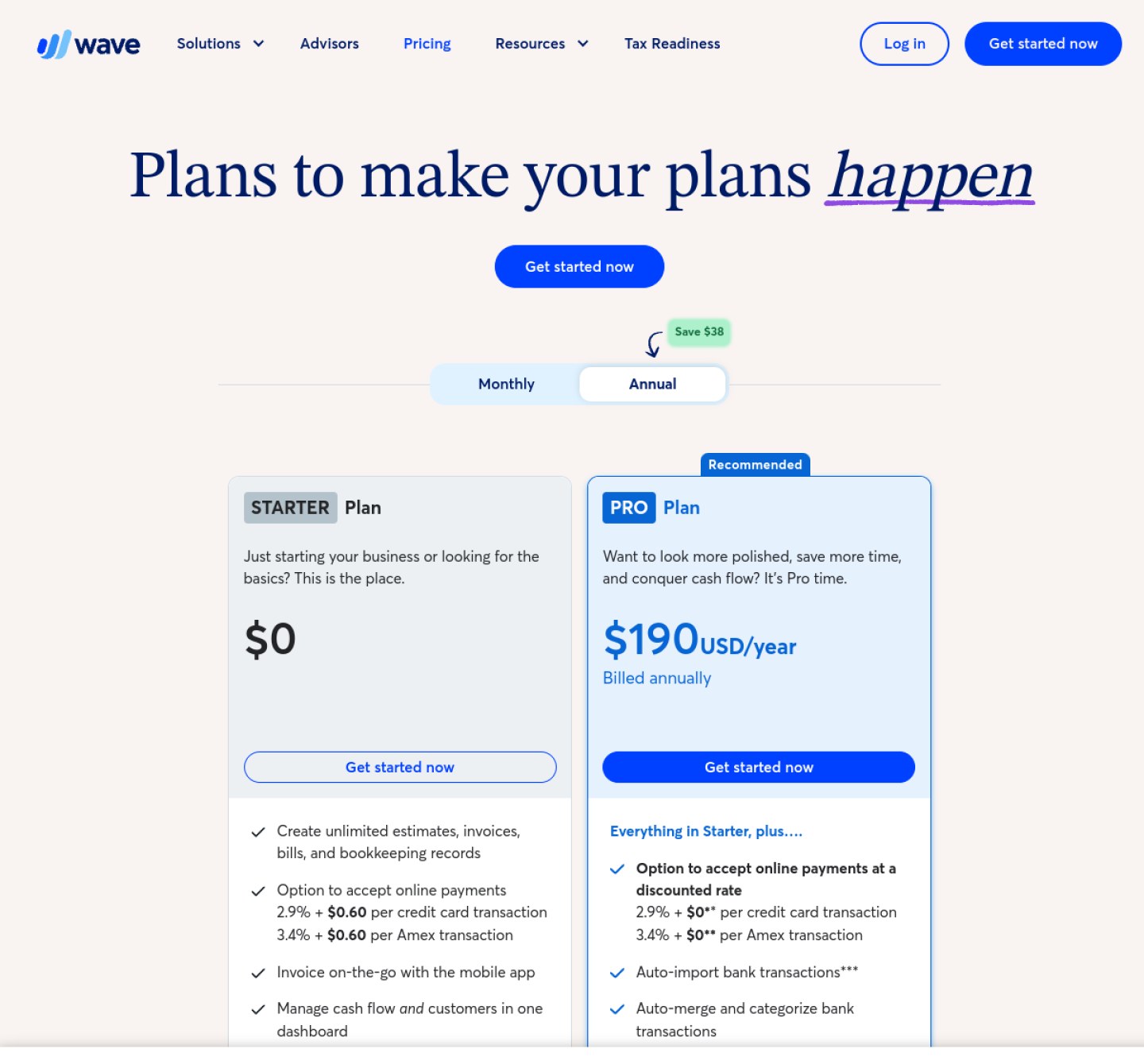
Wave’s Starter plan costs nothing and, unlike most free tiers, it does not ration the core job: unlimited estimates, invoices, bills and bookkeeping records on the free plan. Invoicing works from the mobile app, cash flow and customers sit in one dashboard, and card payments are available at 2.9% plus $0.60 per transaction. For a new business whose accounting is a handful of invoices a month, this is a complete set of books at $0.
What the Pro plan sells, at $19 a month or $190 a year, is automation rather than capacity. Pro imports bank transactions automatically and categorizes them, lets you add users to the account, includes unlimited receipt capture, and drops the fixed fee on your first ten card payments each month. On Starter, receipt scanning alone is an $8 a month add-on, and payroll starts at $40 a month on either plan. So the honest reading of Wave is: free buys the records, Pro buys the hours back.
What we like
- A genuinely free plan with unlimited invoicing
- No per-invoice or per-record caps on either plan
- Pro is a flat $190 a year, no seat maths
What could be better
- Bank imports and categorization sit behind Pro
- Receipt capture costs extra on the free plan
- Payroll is a $40 plus add-on on both plans
Accounting software bills you in three currencies: users, clients and invoices. The cheapest plan is the one whose meter you barely move.
What a year on each tool actually costs
Entry prices flatter every tool on this page, so here is the same shortlist costed over twelve months at standard rates, on the plan a typical small business would actually run. Promotions are excluded, and so is payroll, which every vendor here sells separately.
| Tool | Plan costed | 12 months | What caps it |
|---|---|---|---|
| Xero | Growing, $59 a month | $708 | Nothing per person, no user fees |
| QuickBooks Online | Essentials, $85 a month | $1,020 | 3 users (Simple Start is $456 for one user) |
| FreshBooks | Plus, $43 a month | $516 | 50 billable clients |
| Zoho Books | Standard, annual billing | $180 | 3 users, 5,000 invoices a year |
| Wave | Pro, annual billing | $190 | Nothing, Starter is $0 |
The spread is the story: the same business can spend $180 or $1,020 a year on its books, and the difference is rarely features. It is whether the plan’s meter counts the thing your business has plenty of.
How we checked
Every price, limit and plan detail in this guide to cloud accounting software for small business comes from the five vendors’ official pricing pages, checked in October 2026, and the screenshots above are those same pages. Standard monthly or annual rates are quoted throughout; where a vendor is running a temporary discount, the article names it and still uses the standard rate, because the discount ends and the standard rate is what you renew at.
Our verdict
Xero takes the top score, 9.0, because its bill is the easiest to predict: the price on the plan is the price for your whole team. QuickBooks Online, 8.9, is the safer pair of hands when your accountant already works in it, and FreshBooks, 8.8, wins when invoicing is the job you do all day. On a tight budget, start free and mean it: Zoho Books, 8.7, if you want a cheap ladder to climb later, Wave, 8.3, if free is the whole budget. The one real mistake in this category is paying per user for seats nobody ever logs into.
Setting up the rest of the toolkit alongside the books? Our guide to the best CRM tools covers the other system most small businesses buy first, and the full Accounting section collects every checked comparison in this category.
Frequently asked questions
Which cloud accounting software for a small business costs the least?
Free is cheapest, and two free plans here are genuinely usable: Wave Starter, with unlimited invoicing, and Zoho Books Free, with up to 1,000 invoices a year and over 50 reports. The cheapest paid year is Zoho Books Standard at $15 a month on annual billing, $180 across the year.
Should a very small business pay for QuickBooks Online?
It can be, for one specific reason: if your accountant or bookkeeper already works in QuickBooks, matching their tool saves real hours at tax time. On features per dollar alone, a one person business pays $38 a month for a single user seat, while Xero starts at $27 with no per-user fees and Zoho Books undercuts both.
Which of these tools charges no per-user fees?
Xero is the clear one: no per-user licence fees on any plan, so staff and your accountant can all be in the books at one price. Zoho Books prices per organization with users included in each tier and charges $2.50 a month for extra users. QuickBooks Online and FreshBooks both meter people, QuickBooks by user seats and FreshBooks by team members at $11 each.
What happens if I change accounting software mid-year?
Nothing breaks, and owners do it all the time. The clean moments are the start of a quarter or the tax year, when you can set opening balances and connect bank feeds from a tidy cut-off point. Your invoices, contacts and chart of accounts export from all five tools here, and it is worth keeping the old account open in read-only form until your accountant has closed the year.
Sources: QuickBooks Online, Xero, FreshBooks, Zoho Books and Wave official pricing pages, checked October 2026.