

Most CRMs are built for sales teams with managers, quotas and weekly pipeline meetings. Capsule was built for the other kind of business: a small team, sometimes a team of one or two, that needs its contacts, deals and follow ups in one tidy place and does not want to spend a weekend learning the software. It has been doing that one job since long before the current wave of AI tools arrived.
Capsule already appears in our guide to the best CRM for solopreneurs, where it earned its place with a genuinely free plan and simple pricing. This Capsule CRM review goes deeper: what the free plan really allows, what each paid plan adds, and where the limits sit. Every price and limit below was checked on Capsule’s official pricing page in October 2026.
The quick facts
Free plan: $0, up to 2 users and 250 contacts, no credit card required. Paid plans: Starter $18 per user per month billed annually, Growth $36, Advanced $54. Starter, Growth and Advanced each begin with a 14 day free trial, and signing up needs no card. Email marketing is handled by Transpond, Capsule’s own add on product, which connects natively.
Capsule CRM review: what it actually does
The core of Capsule is a contact book that remembers everything. Every person and company gets a record holding their details, notes, files, tasks and the full history of emails and calls, so opening a contact shows the whole relationship on one page. For a small business, that one joined up view covers most of what a CRM is for.
On top of the contacts sit the sales pipelines. Deals, called opportunities, move through stages you can rename, with a board view for dragging work from one stage to the next. Capsule also includes project boards for the work that happens after a deal is won, plus a task list and calendar for follow ups, so the reminder to chase a quote lives next to the quote itself.
Email is connected rather than copied. You can send from your Gmail or Outlook account inside Capsule, and on the Growth plan, email sync logs messages against the right contact automatically. A shared mailbox arrives on the Starter plan, so addresses like sales@ or support@ can be answered by the whole team from one inbox.
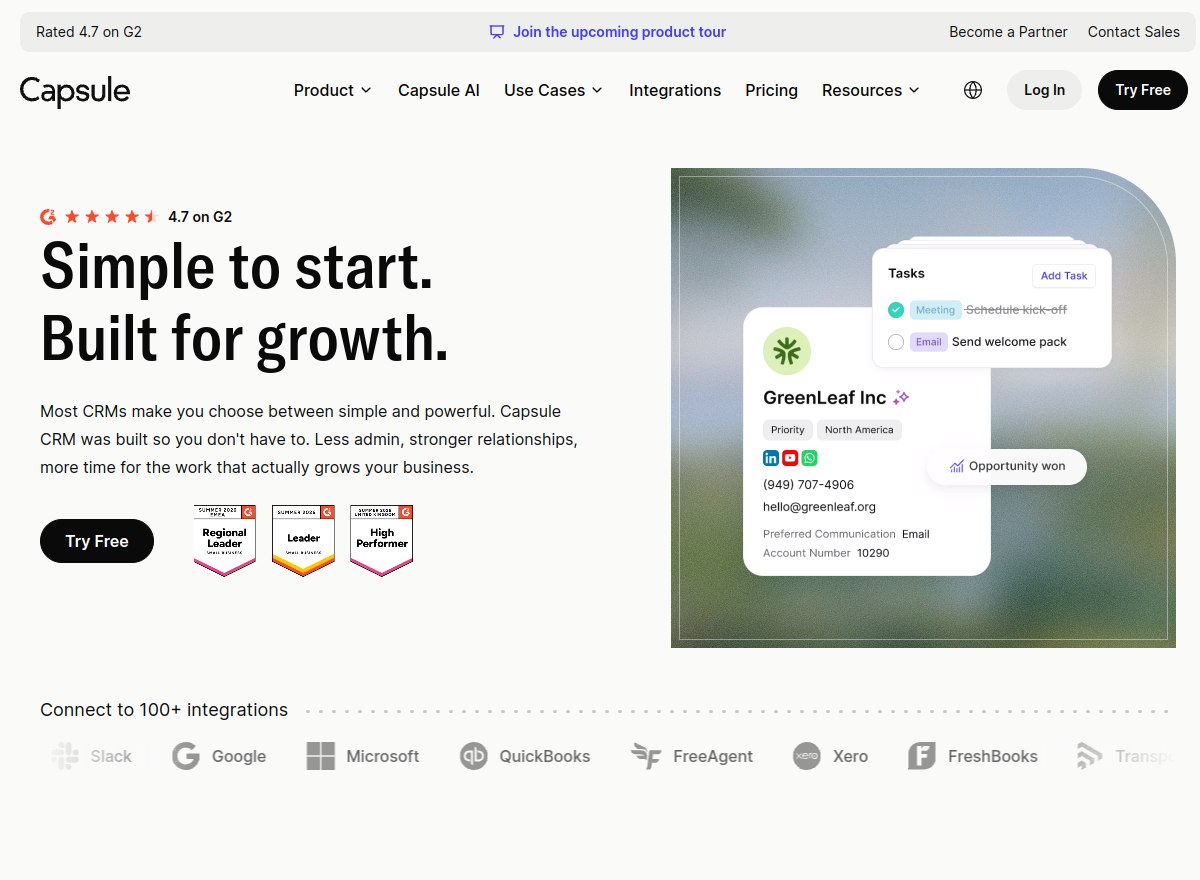
The integration list runs to more than 100 tools, and the useful names for small businesses are there: Xero and QuickBooks for accounting, Slack, Google and Microsoft apps, FreshBooks and Capsule’s own marketing product, Transpond. If your invoices already live in Xero, that connection alone saves real admin time every week.
The newer AI features are deliberately modest. The Starter plan includes an AI pipeline generator that drafts a sales pipeline from a description of your business. Growth adds AI enrichment that fills in missing contact details, AI summaries of the recent activity on a record, and an AI meeting prep brief that is still marked as a beta feature.
Capsule does not try to be the biggest CRM in the room. Its whole aim is to be the CRM you open first each morning.
The free plan, limit by limit
The free plan is a real product, not a timed demo. It costs $0, needs no credit card, and allows 2 users, 250 contacts, 5 custom fields and 1 sales pipeline. For someone moving off a spreadsheet or a phone’s contact list, that covers the basics honestly: who people are, what stage each deal sits at, and what needs doing next.
The boundaries are worth knowing before you settle in. With 250 contacts, an active business can outgrow the free plan within months. Custom sales milestones, custom task categories and the advanced mail connection are paid features, so the free version keeps your workflow in Capsule’s standard shape. And with one pipeline, a business that sells two very different things will feel the squeeze early.
Read the free plan as a long test drive with a low ceiling. It is enough to learn whether Capsule’s calm style suits you, and the upgrade it points to, Starter, is one of the cheaper paid CRMs on the market.
Capsule pricing, checked October 2026
Capsule charges per user, per month, and shows its prices in US dollars. Paying annually saves up to 18% against monthly billing, so the annual figures below are the ones most small teams will actually pay.
| Plan | Per user per month (annual) | Per user per month (monthly) | Contact limit |
|---|---|---|---|
| Free | $0 | $0 | 250 |
| Starter | $18 | $22 | 30,000 |
| Growth | $36 | $40 | 60,000 |
| Advanced | $54 | $60 | 120,000 |
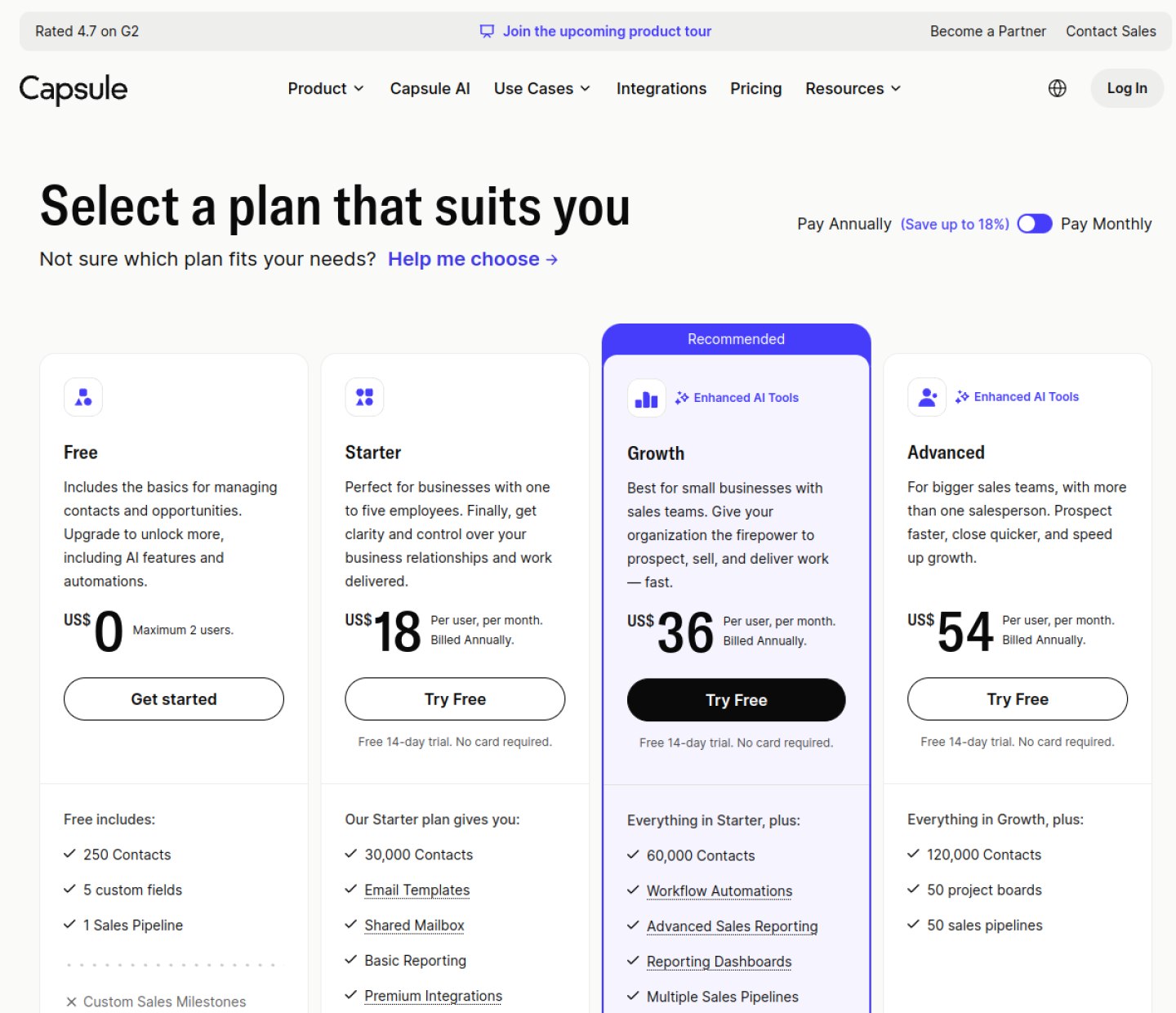
Starter, $18 per user per month billed annually, is the plan that removes the free plan’s ceiling: 30,000 contacts, email templates, a shared mailbox, basic reporting and the premium integrations, including Xero and Zendesk. One user on Starter pays $216 across a whole year, a modest sum for the system a whole business runs on.
Growth, $36 per user per month billed annually, is the plan Capsule itself marks as recommended, and the feature list explains why. It adds workflow automations, multiple sales pipelines and project boards, advanced sales reporting with dashboards, email sync and the AI enrichment and summary tools. At $432 a year for one user, this is the tier where Capsule stops being a contact book and becomes a small sales system.
Advanced, $54 per user per month billed annually, mainly buys room: 120,000 contacts, 50 project boards and 50 sales pipelines, for $648 a year per user. A fifth tier, Ultimate, sits above it for larger teams that want a dedicated account manager. Starter, Growth and Advanced can each be tried free for 14 days with no card required. Ultimate works differently: you request a trial and Capsule’s sales team follows up, and it is aimed at teams of 5 or more users. The sensible route is still to test Growth, the plan most growing teams end up on, before paying anything.
How Capsule pricing compares
Against the other small business CRMs in our guide, Capsule sits in the middle on price and near the top on simplicity. Pipedrive’s Lite plan undercuts it at $14 per seat per month billed annually, but Pipedrive has no free plan at all. Zoho CRM’s Standard plan also costs $14 per user per month annually and its free plan covers 3 users, though many readers find Zoho busier to run day to day.
HubSpot’s free CRM covers 2 users with no contact cap as tight as 250, then jumps to paid sales seats. That is why this Capsule CRM review places Capsule in the calm middle ground: start free, then step up through $18, $36 and $54, numbers you can explain to a business partner without a spreadsheet.
What we like
- A real free plan with 2 users, not a timed trial dressed up as one
- Simple, honest pricing: four paid tiers plus a free plan, no setup fees, cancel any time
- Contact records that gather notes, files, tasks and email history in one view
- Accounting integrations with Xero and QuickBooks that small businesses actually use
- Growth adds automations, multiple pipelines and email sync at a fair $36
- Transpond, its own email marketing product, connects natively instead of through a third party bridge
What to watch
- The free plan’s 250 contacts run out fast for an active business
- Email marketing is a separate add on product, not built into the CRM plans
- Reporting on the lower plans is basic; the useful dashboards wait for Growth
- Workflow automation also waits for Growth, so Starter is a manual CRM
- No phone support positioning; help runs through its support center and email
Who should buy Capsule, and who should skip it
The short answer of this Capsule CRM review: Capsule suits a small team that wants its first real CRM, or is escaping a heavy one. If your week is quotes, follow ups and repeat customers, and your accounts live in Xero or QuickBooks, Capsule’s shape fits: tidy contacts, a pipeline you can see at a glance, and prices that stay predictable as you add a second or third person.
Skip it if marketing automation is the job. Campaigns live in the separate Transpond product, and a dedicated email platform still does more than it. Skip it too if you need deep custom reporting from day one or a free plan with thousands of contacts: our CRM guide covers HubSpot’s free plan and Pipedrive’s sales first approach, and one of those will fit better.
How this review was checked
Prices, plan limits and feature lists were read on Capsule’s official pricing and product pages in October 2026, and the pricing screenshot above is from that check. We do not use vendor review copies or sponsored placements, and no score on this site can be bought. Capsule also features in our wider CRM comparison, scored on the same points.
Our verdict
This Capsule CRM review scores it 8.4 because it respects the way small businesses actually work. The free plan is honest, the paid ladder from $18 to $54 is easy to follow, and the features arrive in a sensible order, with automations and proper reporting landing exactly where growing teams start asking for them. It will not run a marketing department, and it does not pretend to. As a simple CRM that keeps every customer relationship in one calm place, it is one of the safest recommendations we make.
Capsule CRM
A calm, simple CRM for small teams: contacts, pipelines and tasks without the bloat, on fair prices that start free.
Visit Capsule CRMFrequently asked questions
Is Capsule CRM really free?
Yes, it is properly free: $0, no card asked for, and no expiry date waiting at the end of a trial. It covers up to 2 users, 250 contacts, 5 custom fields and 1 sales pipeline. Paid features such as custom milestones and multiple pipelines need a paid plan.
How much does Capsule CRM cost per year?
For one user on annual billing, Starter is $216 a year, Growth is $432 a year and Advanced is $648 a year. Monthly billing costs more: $22, $40 and $60 per user per month. The trial terms were checked for this Capsule CRM review too: on Starter, Growth and Advanced the trial runs 14 days and starts without a card; Ultimate trials are arranged through Capsule’s sales team.
Does Capsule CRM include email marketing?
Partly. Capsule itself sends everyday email through your connected Gmail or Outlook account, with templates on paid plans. Full campaigns, forms and marketing automations run in Transpond, Capsule’s own email marketing product, which integrates with the CRM natively and is priced separately. Transpond plans start from $11 per month.
Capsule or Pipedrive: which should a small team pick?
Pipedrive’s Lite plan costs less per seat at $14 a month billed annually and is built purely around the sales pipeline, but it has no free plan. Capsule gives you a free starting point, calmer contact management and strong accounting integrations. Our full CRM guide compares both side by side.
Sources: capsulecrm.com pricing and product pages, checked October 2026.